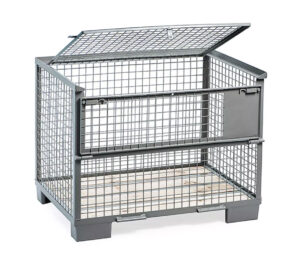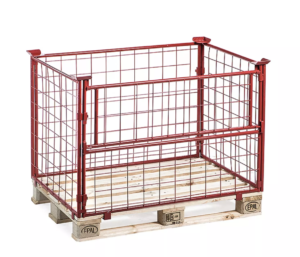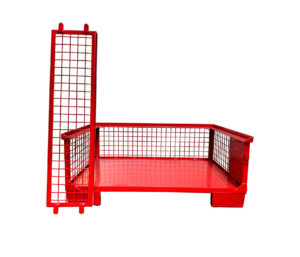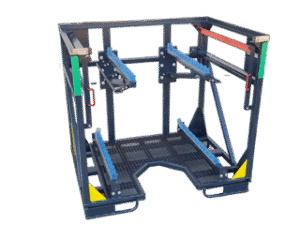


In many warehouses, production halls or industrial plants, standard wooden or plastic pallets cannot always cope with the requirements of durability, load-bearing capacity and flexibility. This is where metal pallets with posts - constructions which combine the strength of steel with modular functionality. In the following text, I explain what such pallets are, what advantages they have, where they prove themselves, what variants DAJANO can offer and answer the most common questions.
What are bar pallets and how do they work?
Pallet structure with uprights
A post pallet is a structure in which the main load-bearing elements are standpipes (or vertical tubes) fixed at the corners and/or at regular intervals along the sides. On these rests a platform (pallet base), often made of sheet metal or steel trusses, which serves as a loading surface. The posts act as vertical stops, stabilising the load and allowing stacking (stacking of pallets on top of each other).
Posts can be:
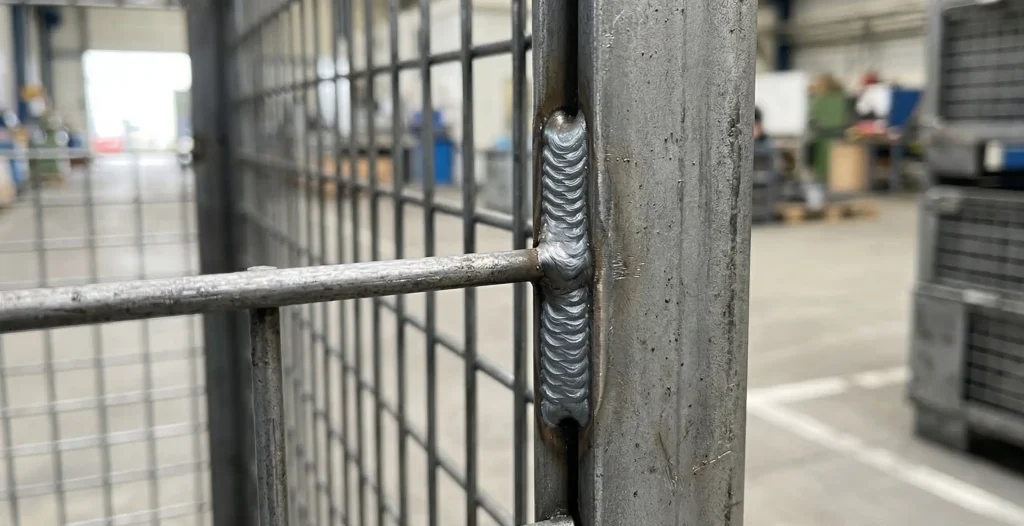
- welded - permanently fixed to the base,
- screwable / removable - allowing the pallet to be dismantled (e.g. for transporting empty units).
These structures are often either galvanised or powder coated to increase resistance to corrosion and external agents.
How do they differ from classic metal and wooden pallets?
Pillar pallets exhibit the advantages typical of steel structures - rigidity, resistance and durability - but additionally offer load stability thanks to their vertical elements, making them more functional in warehousing and logistics applications.
Comparative table of pallet types
| Feature | Pole pallets | Classic metal / steel pallets | Wooden / plastic pallets |
|---|---|---|---|
| Load stabilisation | The uprights reduce load shifting and improve stability | Additional banding or side covers sometimes required | Little off-band stabilisation |
| Stacking | Height and floor can be set | Stackable, but less flexible | Often limited (due to construction) |
| Disassembly / assembly | Screw-in structures make it possible to assemble | As a rule, rigid structures | Not applicable (solid structures) |
| Resistance to external conditions | Steel, galvanised, anti-corrosion coatings | Very durable, but sensitive to moisture without protection | Wood soaks up water, prone to mould; plastic better, but less rigid |
| Load-bearing capacity and durability | Large, heavy load capacity | Also high, but not always with bar elements | Limited compared to steel |
Why use post pallets in storage and transport?
Below is a list of key advantages of metal post pallets and their applications:
- Load stability during stacking
The uprights limit the movement of the load, and the design allows pallets to be stacked - making efficient use of the warehouse's vertical space. - Protection of goods against displacement and damage
The design with vertical restraints reduces the risk of displacement, bruising or friction of transported components - particularly important with irregular shapes or large dimensions. - Versatility of applications
Pole pallets can replace shelving units or be used as mobile storage units - they do not need to be permanently fixed to the floor and can be moved at will. - Flexibility of expansion and adaptation
You can choose the height of the uprights, several floors, change configurations as required - allowing the system to be adapted to different ranges and changing conditions. - Space-saving
Thanks to stacking and the efficient use of vertical storage space, more goods can be stored in the same area. - Durability and material resistance
Made of steel, with protective coatings (galvanised, powder-coated), resistant to corrosion, moisture, mechanical damage. Non-reactive to water, does not absorb moisture. - Easy to clean and hygienic
The smooth steel surface does not absorb dirt - dirt, oils, residues are easily removed - an advantage in industries requiring cleanliness. - Compatibility with storage and transport systems
Pole pallets often have dimensions in line with Europallets or standard warehouse dimensions, which facilitates integration into racking systems and forklift trucks. - Mobility and flexibility of the system
As the pallets do not need to be permanently fixed to the floor, they can be easily rearranged, reorganised the warehouse or moved to another location without costly disassembly.
These advantages make post pallets a stable, flexible and durable solution for modern warehousing and logistics.
Which industries use bar pallets most frequently?
Metal industry
In industrial plants, post pallets are used to transport and store heavy components. The stability and robustness of their construction make them the ideal choice where precision and reliability are required.
Construction and logistics of heavy materials
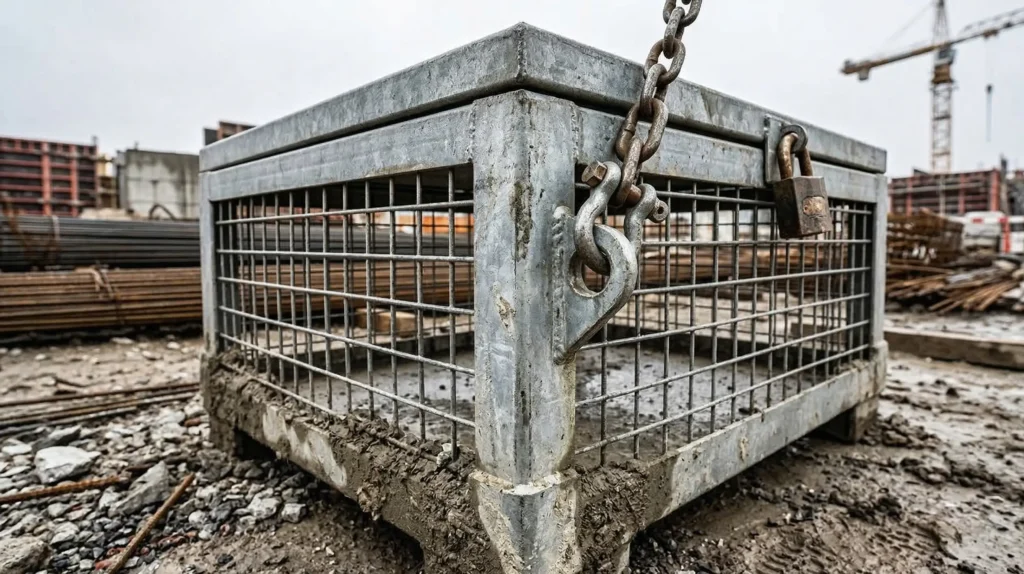
Building materials, steel profiles, beams, prefabricated slabs - post pallets allow them to be stored with vertical stability, often replacing shelving or facilitating mobile storage on construction sites. DAJANO itself highlights the use of post pallets on construction sites as a way to save space and facilitate logistics.
Types of bar pallets available at DAJANO
Pallets with welded tubes
- Welded tubes - Solid, robust construction with no loose parts.
Pallets with solid and grid floors
- Solid steel plate - ideal for transporting general cargo, provides an even surface.
- Mesh / lattice plate - lightweight design, improved ventilation and dirt evacuation, useful where cleanliness control or liquid run-off is required.
Standard solutions and customised production
DAJANO can offer post pallets in standard dimensions (e.g. 1200×800 mm, other proportions) and customised pallets: dimensions, post heights, load capacity, protective coatings, dismantling options.
What are the advantages of the DAJANO post pallets?
High load-bearing capacity and durability of construction
Thanks to the steel construction and reinforced components, DAJANO post pallets are able to carry heavy loads without deformation - ensuring durability for years.
Space-saving
The stacking and stacking capability of the post pallets allows maximum use of warehouse height, and the collapsible structures (where available) reduce the volume of empty units when returning or storing.
DAJANO also emphasises that post pallets allow „to organise materials, secure cargo and save space” on construction sites and warehouses.
Metal post pallets - Frequently asked questions
What is the load capacity of a single post pallet?
The load-bearing capacity depends on the thickness of the materials, type of construction and reinforcements. In industrial applications, it can be hundreds of kilograms or even tonnes. However, the exact parameter should be specified by the manufacturer or in the technical documentation.
Does DAJANO make customised pallets?
Yes - the range of post pallets includes bespoke solutions, tailored in terms of dimensions, load capacity, materials, protective coatings or dismantling to meet specific customer needs.
What is the ordering and delivery process like?
Typically, the process includes: consultation and requirements analysis, technical design, quotation, production (cutting, welding, assembly, coatings), quality control, packaging and delivery to the customer. Timing depends on the complexity of the design and availability of materials.
Do you need a metal pole pallet? Contact us ✅
How helpful was the article?
Click a star to rate!
Average rating 4 / 5. Number of votes: 4
No votes so far! Be the first to rate this article.
How helpful was the article?
Click a star to rate!
Average rating 4 / 5. Number of votes: 4
No votes so far! Be the first to rate this article.
 Polski
  English (UK)
  Français
  Čeština
  Svenska