

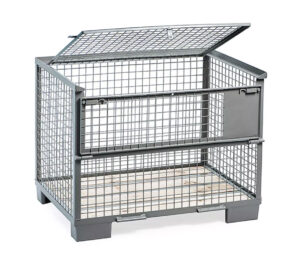
Manufacturing stages of a bespoke container - how does it work at DAJANO?
The flowchart below describes the sequence of steps that a customised container project should follow - with an emphasis on quality, communication with the client and implementation in line with expectations.
- Consultation and analysis of customer needs
The first step is to talk to the client - gathering requirements, goods specifications, working environment, transport and storage conditions. We give the customer a questionnaire or checklist to help define: dimensions, load capacity, shapes, loads, environmental conditions (humidity, temperature, chemicals) and integration with other systems. - Development of technical design and visualisation
Based on the data, a 2D / 3D design of the container is created, often in CAD software. The customer receives visualisations and technical drawings, and can make comments or modifications - this is an iterative stage. - Quotation and acceptance of technical parameters
Once the technical design is accepted, we proceed to a quote - materials, machining, coatings, additives. Once the terms are accepted (price, deadline, quantity), a contract or production order is signed. - Production - cutting, welding, powder coating
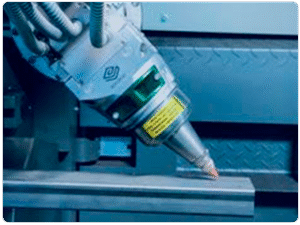
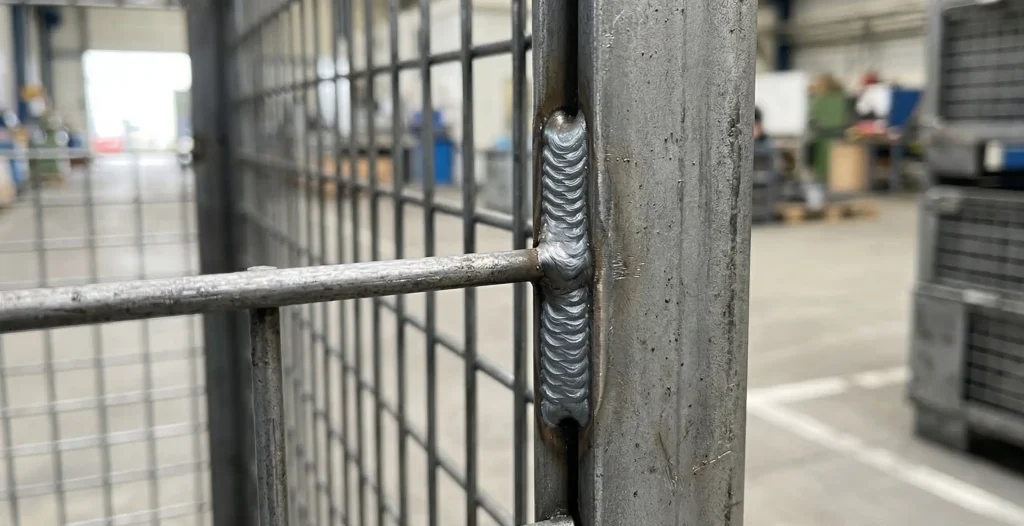
In the production phase, the raw material (steel sheet, profile parts) is prepared: laser cutting, bending, stamping. The components are then welded, assembled and assembled. Assembly is followed by surface treatment (grinding, deburring) and finally powder coating or other protective finishes. - Quality testing and control of compliance with standards
Each finished container undergoes dimensional inspection, weld tests, load bearing capacity, stability and possible mechanical tests. Where necessary, tests for compliance with industry standards and customer specifications are carried out. - Packaging, delivery and after-sales support
Containers are packed, loading is organised according to transport conditions.
Expert comment:
- Kamil Chenczke, DAJANO Construction Department
What can be personalised in the container?
One of the biggest advantages of bespoke manufacturing is the wide range of modifications that can be made to ensure that the final product exactly meets the customer's needs.
Dimensions and load capacity
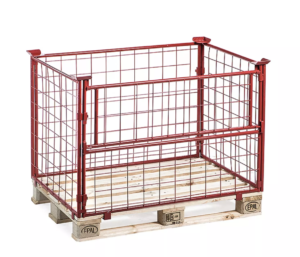
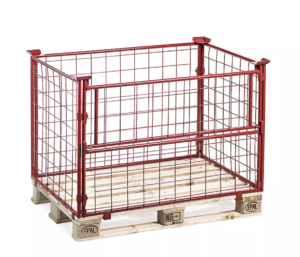
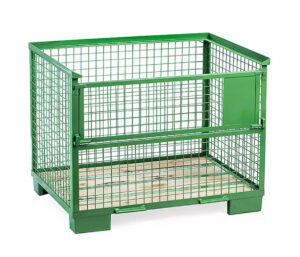
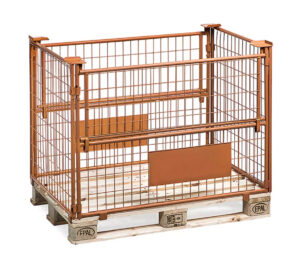
The most commonly adjusted parameters: length, width, height. In addition, refinements are made to carrying capacity -1,000 kg or 1,500 kg - depending on the intended load and conditions of use. Additional reinforcements (profiles) can be added to the containers to increase the load capacity or to keep the structure lean.
Type of floor (wooden, steel)
Depending on the type of load, the following can be used:
- wooden flooring (e.g. plywood, boards) - for easier cushioning and friendlier contact with delicate goods,
- steel flooring - more durable, abrasion-resistant, moisture-resistant,
- perforated or grating surfaces - where ventilation or drainage is required.
Flaps, doors, ears, catches
A bespoke container can have different functional elements:
- flaps or doors with locks, hinges,
- ears and handles for manual lifting, trolleys or cranes,
- hooks, hooks for suspension, lashing, handling.
Foldable and stackable
To save storage and transport space, it can be designed:
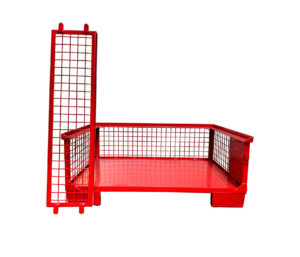
- folding containers (folding side walls),
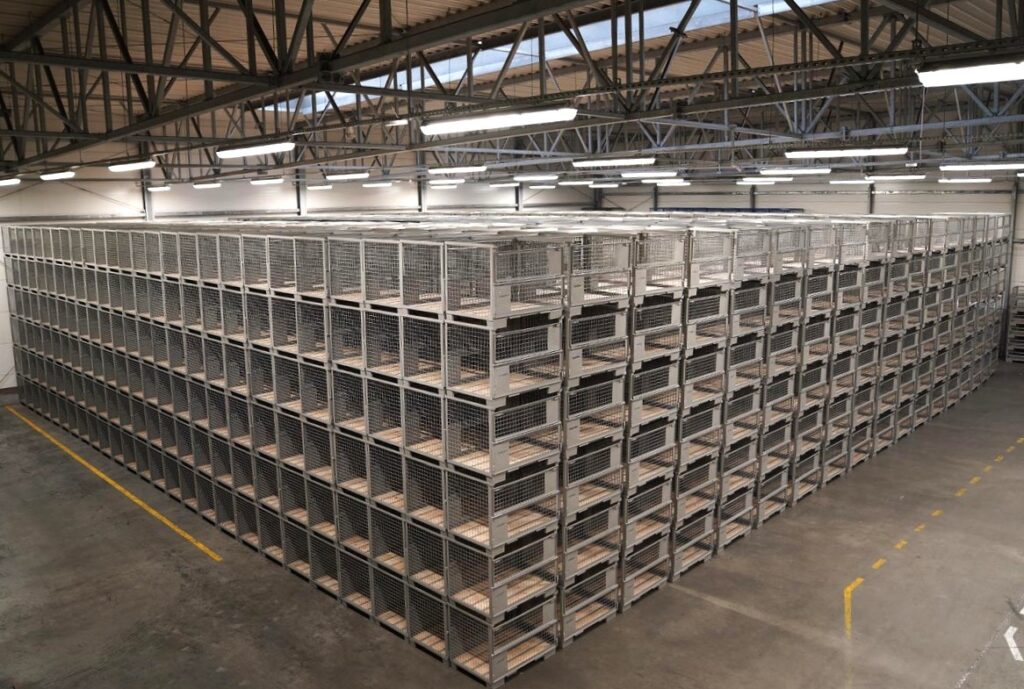
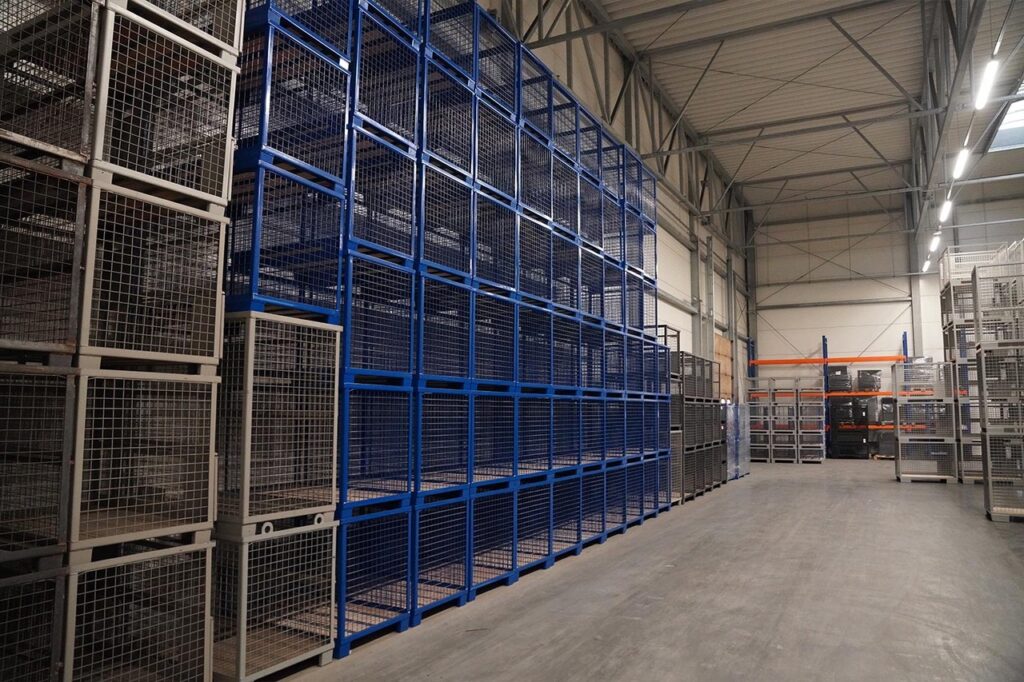
- stackable structures (when empty, they can be stacked or stacked with extensions).
Powder coating in a specific colour or with the customer's logo
Protective coatings are not only a protective layer, but also an element of identification. Can be ordered:
- colour compatible with company colours,
- logo, lettering on plate (e.g. stock number, SKU or serial number) printed or laser-embossed,
- special coatings (anti-corrosive, chemically resistant paints, epoxy coatings).
Industries that make most use of bespoke containers
Some sectors particularly benefit from the opportunity to create a dedicated container that fits perfectly with the nature of their operation.
Automotive
In the automotive industry, there are parts with different dimensions, unusual shapes, which require precise storage and transport. Containers adapted to the components (e.g. bodywork, rubber parts, small parts) significantly reduce damage and improve picking.

Agriculture
Seasonal produce, fluctuating volumes, the need for protection from the weather - durable, easy-to-clean and moisture-resistant containers are important for agriculture. Adapting containers to the specific characteristics of agricultural produce (e.g. delicate fruit) avoids losses.
Construction
Building materials - heavy, bulky or customised - require robust structures. Metal containers with reinforcements and a high load capacity are perfect for this sector.
E-commerce warehouses
E-commerce is characterised by a large number of SKUs, fast shipping speeds and the need for flexibility. Dedicated containers for parcel complexation, for pick zones, for returns (reverse logistics) speed up processes and reduce errors.
Transport
Transport companies often need containers that fit perfectly into the loading space of trailers or containers. Special containers (of a specific size, stacked design) allow better utilisation of the transport space.
 Polski
  English (UK)
  Français
  Čeština
  Svenska